
Deciding to move to SAP S/4HANA is one thing. Knowing exactly what the project actually involves — who does what, in what order, and how long each stage realistically takes — is a different problem entirely, and it’s usually the part that catches businesses off guard. A migration that seems straightforward on paper can turn chaotic fast without a clear roadmap to follow.
The good news is that SAP implementations aren’t guesswork. Most successful projects follow SAP’s own Activate methodology, a structured framework built specifically for S/4HANA rollouts. This guide walks through each phase of that roadmap in plain language, so you know what to expect before your project starts — not halfway through it.
What is the SAP S/4HANA Implementation Roadmap?
An implementation roadmap is simply the structured path a business follows to move from its current system — usually SAP ECC or a non-SAP legacy platform — to a fully live S/4HANA environment. It covers everything from the initial assessment of what you have today, through configuration and data migration, to the point where your teams are working in the new system day to day.
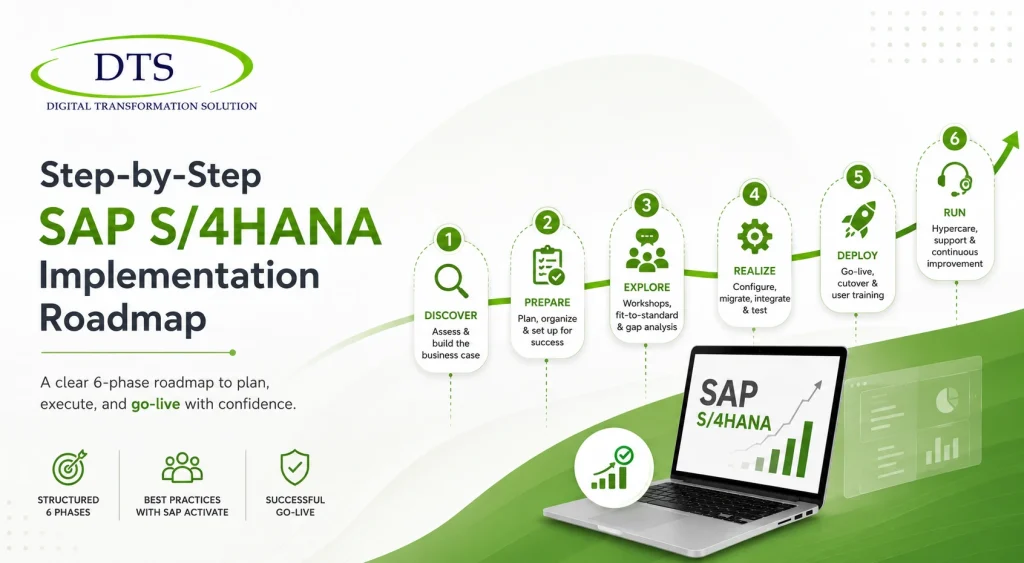
Most SAP partners build their roadmaps around SAP Activate, SAP’s official methodology for implementations and upgrades. It breaks the project into six phases: Discover, Prepare, Explore, Realize, Deploy, and Run. It’s not just a theoretical framework — it’s the same structure SAP itself recommends, and it gives every stakeholder, from IT to finance to end users, a shared understanding of where the project stands at any given point.
Greenfield vs Brownfield vs Selective Transition: Choosing Your Path First
Before the roadmap really begins, there’s a decision that shapes everything downstream: which implementation path fits your business.
- Greenfield means implementing S/4HANA as a clean, new system, redesigning processes around SAP’s best practices rather than carrying over old customizations. It suits businesses ready for genuine process transformation.
- Brownfield means converting your existing ECC system directly to S/4HANA, keeping most of your current configuration and customizations intact. It’s typically faster and less disruptive for businesses whose current processes work well.
- Selective transition sits between the two — migrating specific business units, processes, or data selectively, which allows more control but requires more careful planning.
There’s no universally correct choice. A business with heavily customized, well-functioning processes often leans brownfield. A business that’s outgrown its old setup, or wants to eliminate years of accumulated technical debt, often leans greenfield. This decision typically happens during the Discover phase, which is where the roadmap officially begins.
The 6 Phases of SAP S/4HANA Implementation
Phase 1: Discover
This is the foundation phase, and skipping or rushing it is one of the most common reasons implementations run into trouble later. During Discover, your team — often working with an implementation partner — assesses your current systems, runs SAP’s Readiness Check to flag technical gaps, and builds the initial business case. This is also when the greenfield-vs-brownfield decision gets made, based on what the assessment reveals about your existing landscape.
Phase 2: Prepare
With the assessment complete, Prepare is where the project actually gets organized. This includes setting up the project team, defining governance and reporting structures, confirming scope and timeline, and getting the technical environment ready. A well-run Prepare phase sets the tone for everything that follows — rushed planning here tends to surface as delays much later in the project.
Phase 3: Explore
Explore is where your business processes meet SAP’s standard functionality. Through structured workshops, your team walks through how S/4HANA handles each process and identifies where standard functionality fits and where gaps exist. The goal here is “fit-to-standard” — adopting SAP’s built-in best practices wherever possible, and only customizing where there’s a genuine business reason to. Every unnecessary customization added here adds cost and complexity later, so this phase deserves real scrutiny rather than being treated as a formality.
Phase 4: Realize
This is the longest and most technical phase. Realize covers system configuration, data migration from your legacy environment, integration with other business systems, and rigorous testing across every process identified in Explore. Custom code that’s still needed gets remediated for S/4HANA compatibility here as well. By the end of Realize, the system should be functionally complete and tested — not just installed, but genuinely ready for real business use.
Phase 5: Deploy
Deploy is the go-live phase: final data loads, cutover execution, and the actual switch from your old system to S/4HANA. This is typically the most tightly planned stage of the whole project, often executed over a weekend or planned downtime window to minimize business disruption. End-user training usually ramps up heavily just before this phase, so teams aren’t learning the new system and doing their jobs at the same time.
Phase 6: Run
Implementation doesn’t end at go-live. The Run phase, often called hypercare in the weeks immediately after launch, is where issues get resolved quickly, performance gets fine-tuned, and users get hands-on support while they adjust to the new system. Beyond hypercare, Run continues as ongoing optimization — refining processes, adopting new features SAP releases, and making sure the system keeps delivering value rather than just sitting there configured correctly.
Realistic Implementation Timeline
Timelines vary significantly based on company size, complexity, and which implementation path you choose. As a general guide, small and mid-sized businesses running a fairly standard brownfield conversion often complete implementation in four to eight months. Larger enterprises, particularly those choosing greenfield transformation with significant process redesign, more commonly see timelines of twelve to eighteen months, sometimes longer for highly complex, multi-entity organizations. Rushing these timelines to hit an external deadline is one of the fastest ways to end up with an implementation that technically works but doesn’t actually serve the business well.
Common Roadmap Mistakes That Delay Go-Live
- Skipping or rushing the Discover phase, which leaves technical and process gaps undiscovered until much later in the project.
- Underestimating data cleanup — migrating years of messy, duplicate, or outdated data instead of cleaning it up first.
- Treating change management as an afterthought instead of starting it during Explore, well before go-live.
- Over-customizing during Explore instead of committing to fit-to-standard wherever reasonably possible.
- Not building a super-user network to support colleagues during and after go-live.
- Underestimating the Run phase, and pulling project resources away too soon after launch.
Implementation Checklist (Quick Reference)
- Run a readiness assessment and choose your implementation path (greenfield, brownfield, or selective)
- Build your business case and get stakeholder buy-in beyond just IT
- Assemble your project team and confirm scope, budget, and timeline
- Run fit-to-standard workshops and limit customization to genuine business needs
- Migrate and thoroughly test data before go-live, not during it
- Plan cutover carefully and train end users before the switch, not after
- Budget time and resources for hypercare and post-go-live optimization
How DTS Guides Your SAP S/4HANA Implementation
Following a roadmap on paper and actually executing one under real business pressure are two very different things. Our SAP S/4HANA Implementation team works alongside your business through every phase above — from the initial readiness assessment through go-live and beyond — so decisions get made with your actual operations in mind, not a generic template. For businesses converting from an existing SAP environment, our SAP S/4HANA Migration specialists handle the technical conversion with minimal disruption to daily operations.
And the relationship doesn’t end at go-live. Our SAP Support Center stays engaged through hypercare and beyond, so your team has somewhere to turn as they settle into the new system.
If you’re mapping out your S/4HANA journey and want a roadmap built around your actual business, not a generic checklist, that’s exactly where a good implementation partner earns their place.
FAQs
What are the phases of SAP S/4HANA implementation?
SAP S/4HANA implementation follows the SAP Activate methodology, which consists of six phases: Discover, Prepare, Explore, Realize, Deploy, and Run.
How long does SAP S/4HANA implementation take?
It depends on company size and complexity. Small to mid-sized brownfield conversions often take four to eight months, while larger greenfield transformations commonly take twelve to eighteen months or more.
What is the SAP Activate methodology?
SAP Activate is SAP’s official implementation methodology, combining a phased roadmap, pre-built best practices, and guided configuration tools to help businesses implement or upgrade to S/4HANA in a structured way.
What is the difference between greenfield and brownfield implementation?
Greenfield means implementing S/4HANA as a new system built around SAP’s standard best practices, while brownfield means converting your existing ECC system directly, preserving most current configurations and customizations.
What is SAP Readiness Check?
SAP Readiness Check is a tool used early in the Discover phase to assess your current system, flag technical gaps, identify custom code issues, and estimate the scope of work needed before implementation begins.
What comes after go-live in SAP S/4HANA?
After go-live, businesses enter hypercare, a period of close support to resolve issues quickly, followed by ongoing optimization to refine processes and adopt new features as the system matures.