
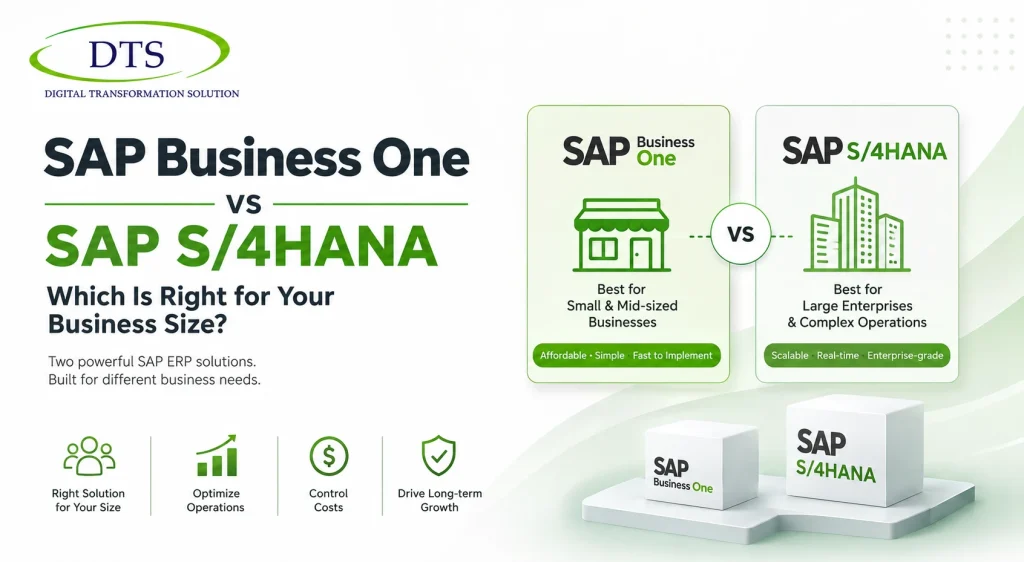
If you’ve started researching SAP as an ERP option, you’ve likely run into this exact question within the first few searches: SAP Business One or SAP S/4HANA? Both carry the SAP name, both promise to bring your finance, inventory, sales, and operations under one roof, and both are backed by the same company. On paper, that similarity makes the choice feel harder than it needs to be.
In practice, the decision usually isn’t close once you look at it the right way. These two systems aren’t different tiers of the same product — they’re built for genuinely different kinds of businesses. Picking the wrong one doesn’t just mean a rough rollout; it means either overpaying for capability you’ll never use, or locking a growing business into a system it will outgrow within a few years. This guide breaks down exactly what separates them, so you can match the system to where your business actually stands — not where a sales pitch says it should be.
SAP Business One vs SAP S/4HANA at a Glance
| SAP Business One | SAP S/4HANA | |
| Built for | Small and mid-sized businesses | Large, complex enterprises |
| Typical complexity | Single entity, straightforward operations | Multi-entity, multi-country, complex processes |
| Implementation time | Weeks to a few months | Six months to two years or more |
| Starting investment | Tens of thousands of dollars | Typically $75,000+ in services alone |
| Interface | Simple, standard reporting | Modern SAP Fiori, role-based dashboards |
| Best fit | SMEs that have outgrown basic accounting software | Enterprises needing real-time, large-scale operations |
What is SAP Business One?
SAP Business One is SAP’s ERP system built specifically for small and mid-sized businesses. It brings together the core functions a growing company needs — financial accounting, inventory and warehouse management, sales, purchasing, and CRM — into a single, integrated platform, without the scale or complexity of SAP’s enterprise-grade products.
It’s typically the natural next step for businesses that have outgrown spreadsheets or entry-level accounting software but don’t yet operate at a scale that justifies an enterprise ERP investment. Manufacturing, distribution, retail, and professional services businesses make up a large share of SAP Business One’s user base, largely because the system covers their core operational needs without demanding a dedicated IT department to run it.
What is SAP S/4HANA?
SAP S/4HANA is SAP’s next-generation enterprise ERP, built natively on SAP’s in-memory HANA database for real-time processing across every part of the business. We’ve covered what it actually is and why businesses are adopting it in more depth in our guide to SAP S/4HANA, but the short version is this: it’s designed for organizations running complex, often multi-entity or multi-country operations, where real-time data, embedded AI, and advanced analytics genuinely change how the business is run — not just how it’s reported on.
Key Differences That Actually Matter
Company size and complexity
This is the differentiator that resolves most of the confusion. SAP Business One is built around the needs of a single-entity or simply-structured business. SAP S/4HANA is built for organizations juggling multiple legal entities, currencies, regulatory environments, and business units at once. A business running one warehouse and a straightforward sales process rarely needs what S/4HANA offers — and a multinational manufacturer rarely fits comfortably inside what Business One was designed to handle.
Database and technical architecture
SAP Business One can run on either SAP HANA or Microsoft SQL Server, giving smaller businesses flexibility in how they deploy it. SAP S/4HANA runs exclusively on the HANA in-memory database, which is precisely what enables its real-time processing at enterprise scale — but that architecture also comes with a higher technical footprint to manage.
Cost and implementation timeline
SAP Business One implementations are typically measured in weeks to a few months, with total investment usually landing in the tens of thousands of dollars depending on scope and customization. SAP S/4HANA is a different category of investment entirely — implementation services alone often start upward of $75,000, with full projects frequently running six months to two years before licensing, infrastructure, and ongoing support are factored in.
Scalability and growth headroom
SAP Business One handles growth well up to a point, but it does have a ceiling — businesses that expand significantly in transaction volume, entity count, or operational complexity eventually start to feel its limits. SAP S/4HANA is built to scale with far less constraint, which is exactly why it’s the standard for large enterprises rather than a stepping stone most SMEs need to reach for early.
Customization and industry-specific needs
Both systems support customization, but at different depths. SAP Business One covers core processes well and integrates with a range of third-party add-ons for industry-specific needs. SAP S/4HANA offers considerably deeper industry-specific functionality out of the box, along with tighter integration across SAP’s broader enterprise ecosystem — valuable when your operations genuinely require it, unnecessary overhead when they don’t.
Which One Should You Choose?
Choose SAP Business One if you’re a small or mid-sized business looking to move beyond basic accounting software, need core finance, inventory, sales, and CRM functionality in one system, and want a manageable implementation timeline and budget.
Choose SAP S/4HANA if you’re operating at enterprise scale, managing multiple entities or complex regulatory requirements, and need real-time analytics and embedded AI to run large, interconnected operations — and have the budget and timeline to match that scope.
It’s also worth knowing you’re not locked into one path forever. Businesses that start on SAP Business One and later outgrow it do have a path to migrate to S/4HANA as their operations expand — so choosing Business One now isn’t a decision you’re stuck with permanently if your business scales significantly.
Cost Comparison: What to Realistically Budget
Exact pricing depends heavily on company size, number of users, chosen modules, and customization needs, so treat the following as general orientation rather than a quote. SAP Business One implementations commonly range from the low tens of thousands of dollars for straightforward deployments to higher figures for more customized, multi-user setups. SAP S/4HANA implementations sit in an entirely different range, with services alone frequently starting around $75,000 and scaling well into the millions for large, complex enterprise rollouts. The right way to think about cost isn’t which system is “cheaper” in isolation — it’s which system’s cost is actually justified by the complexity of what your business needs to run.
Making the Right Choice for Your Business
Getting this decision right at the outset saves significant cost and disruption down the line. Our SAP Business One team helps growing SMEs implement a system sized correctly for their operations today, while our SAP S/4HANA Implementation specialists work with larger organizations that need the full scale and depth S/4HANA offers. If you’re not yet sure which category your business falls into, that’s exactly the kind of question worth working through with an implementation partner before committing to either path.
FAQs
Which SAP is best for small business?
SAP Business One is generally the better fit for small and mid-sized businesses, offering core ERP functionality at a lower cost and shorter implementation timeline than SAP S/4HANA.
Is SAP Business One the same as SAP S/4HANA?
No. They are separate SAP products built for different business sizes. SAP Business One targets SMEs, while SAP S/4HANA is designed for large, complex enterprises.
Can SAP Business One scale to a large enterprise?
SAP Business One can support meaningful growth, but it does have limits. Businesses that scale significantly in size, entity count, or operational complexity often eventually transition to SAP S/4HANA.
What is the cost difference between SAP Business One and S/4HANA?
SAP Business One implementations typically cost tens of thousands of dollars, while SAP S/4HANA implementation services alone commonly start around $75,000 and scale significantly higher for large enterprise projects.
Can I upgrade from SAP Business One to S/4HANA later?
Yes. Businesses that outgrow SAP Business One have a path to migrate to SAP S/4HANA as their operations and complexity expand.
What size company needs SAP S/4HANA?
SAP S/4HANA is generally suited to large enterprises managing multiple entities, complex regulatory requirements, or global operations that need real-time data across the business.
Does SAP Business One use the same database as S/4HANA?
SAP Business One can run on either SAP HANA or Microsoft SQL Server, while SAP S/4HANA runs exclusively on the SAP HANA in-memory database.