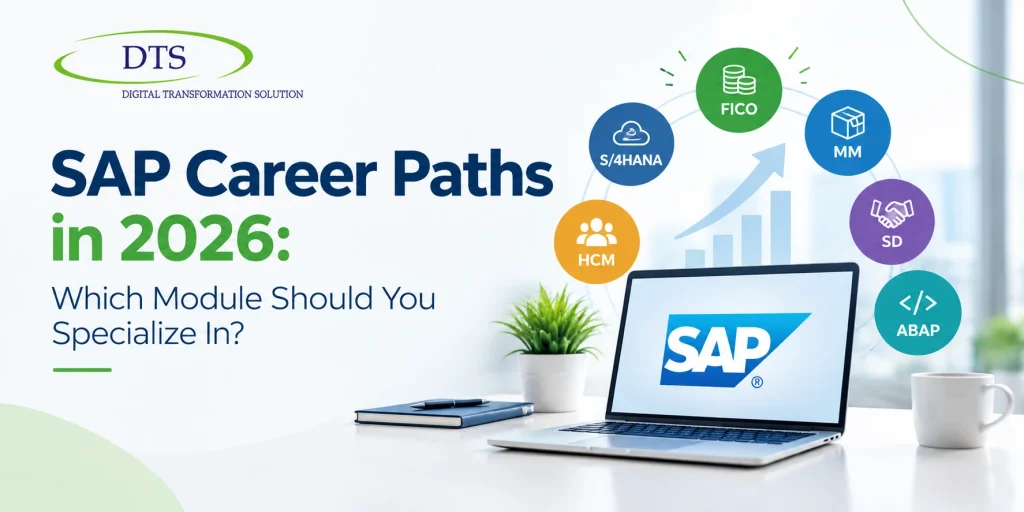
Ask five different people which SAP module is “the best one” to learn, and you’ll likely get five different answers — usually based on whatever module that person happens to know. It’s understandable advice, but it’s not particularly useful when you’re the one trying to decide where to invest months of study and, often, a meaningful chunk of money.
The truth is there isn’t a single best SAP module. There’s a best module for your background, your interests, and the kind of work you actually want to be doing five years from now. This guide breaks down the major SAP career paths in plain terms, so you can make that decision based on what actually fits you — not just whichever course happened to have a seat available.
Why Your SAP Module Choice Matters More Than You Think
SAP consultants tend to specialize early and stay specialized for years, sometimes for their entire career. Switching modules later isn’t impossible, but it usually means starting close to square one in terms of depth and experience, which makes the first choice more consequential than most beginners expect. The module you pick shapes the industries you’ll work in, the kind of problems you’ll solve day to day, and even whether you end up on the functional or technical side of SAP consulting — two career tracks that look and feel quite different once you’re actually working in them.
SAP Career Paths Explained by Module
SAP FICO — Finance and Controlling
SAP FICO covers financial accounting and controlling — general ledger, accounts payable and receivable, cost center accounting, and financial reporting. It’s consistently one of the most in-demand SAP modules because every company running SAP, regardless of industry, needs finance processes configured and maintained. If you have a finance, accounting, or commerce background, this is often the most natural entry point, and consultants who specialize here tend to find work across almost any industry rather than being tied to one sector. Related coverage of financial process modules is available through our SAP Financial Supply Chain Management course, which pairs well with core FICO knowledge for consultants wanting a broader finance specialization.
SAP MM — Materials Management
SAP MM handles procurement, inventory management, and the supply chain side of the business — purchase orders, vendor evaluation, goods receipt, and material planning. It’s a strong fit for people with a background or interest in logistics, supply chain, or operations, and it’s especially in demand among manufacturing, distribution, and retail companies. Consultants in this path often work closely with warehouse and procurement teams, making it a good option for people who enjoy solving practical, operational problems rather than purely financial ones. You can see the detailed curriculum on our SAP Materials Management course page.
SAP SD — Sales and Distribution
SAP SD manages the sales side of the business: order processing, pricing, shipping, and billing — essentially the entire order-to-cash cycle. It suits people who understand or enjoy commercial and customer-facing processes, and it integrates closely with both MM and FICO, which makes it a common second specialization for consultants who started in one of those modules. Demand for SAP SD consultants has stayed steady as more mid-to-large enterprises run their sales operations through SAP rather than standalone CRM tools.
SAP ABAP — the Technical/Development Path
ABAP is SAP’s proprietary programming language, and consultants who specialize in it work on custom development, reports, interfaces, and system enhancements rather than configuring standard business processes. This is the clearest entry point into SAP for people with a programming or computer science background who want to stay on the technical side rather than the functional/business side. ABAP consultants are often the ones bridging the gap between what a business needs and what the standard SAP system doesn’t do out of the box — valuable, specialized work that tends to command strong rates precisely because fewer people do it well.
SAP HCM — Human Capital Management
SAP HCM covers HR processes — organizational structure, employee data, time management, payroll, and increasingly, integration with SAP SuccessFactors for talent management. It’s a natural fit for people coming from an HR or business administration background who want to move into a more technical, systems-focused HR role. As more companies modernize their HR operations, especially with cloud-based tools like SuccessFactors layered on top, demand for consultants who understand both the traditional HCM backbone and its modern extensions has grown steadily. Full curriculum details are on our SAP HCM course page.
SAP S/4HANA Finance — the Modern Upgrade Path
For those specifically drawn to finance, SAP S/4HANA Finance is worth understanding as a distinct, more modern specialization built for the newer S/4HANA environment rather than legacy ECC. As more companies migrate to S/4HANA, consultants who understand both classic FICO principles and the S/4HANA-specific finance architecture are positioned well for the next several years of demand, since that migration wave is still very much in progress across the industry.
Module Comparison at a Glance
| Module | Best For | Path Type | Background Helpful |
|---|---|---|---|
| SAP FICO | Finance, accounting, and controlling processes | Functional | Finance/accounting |
| SAP MM | Procurement, inventory, and supply chain | Functional | Supply chain/logistics |
| SAP SD | Sales, order management, and billing | Functional | Sales/commerce |
| SAP ABAP | Custom development and system programming | Technical | Programming/IT |
| SAP HCM | HR processes, payroll, and talent management | Functional | HR/business admin |
Functional vs Technical Consultant — Which Suits You?
Beyond the specific module, there’s a broader fork in the road worth thinking about early: functional or technical. Functional consultants (FICO, MM, SD, HCM) work closely with business processes, translating how a company actually operates into how the SAP system should be configured — the role leans more toward business analysis and process understanding than deep programming. Technical consultants (ABAP, and increasingly Basis and integration specialists) work on the underlying system itself — coding, customizing, and maintaining the technical infrastructure that functional consultants’ configurations run on. Neither path is objectively better; it largely comes down to whether you’re more drawn to understanding how a business runs, or how the system underneath it actually works.
How to Choose the Right Module for You
- Start with your existing background — finance experience points toward FICO, supply chain toward MM, sales toward SD, programming toward ABAP, and HR toward HCM
- Consider whether you’re more drawn to business processes (functional) or system logic and code (technical)
- Research demand in the specific market you plan to work in — Pakistan, UAE, Saudi Arabia, and the UK each have slightly different demand patterns across modules
- Talk to working consultants in a module before committing months of study to it — the day-to-day reality often looks different from the course description
- Remember that switching later is possible but costly in time — a short career counseling conversation upfront is far cheaper than six months in the wrong course
SAP Career Growth and Salary Potential in 2026
SAP consultants generally see strong earning potential compared to many other IT and business roles, with pay scaling meaningfully as consultants move from entry-level implementation support roles toward senior consulting, project lead, and eventually solution architect positions. Demand has stayed resilient because SAP remains deeply embedded in mid-size and large enterprises across nearly every industry, and the current wave of S/4HANA migrations is actively increasing demand for consultants who understand the newer platform — not just legacy ECC. Consultants who pair a functional or technical specialization with S/4HANA-specific knowledge are generally the best positioned heading into the next few years.
Getting Started on Your SAP Career Path
Choosing a module is the first real decision in an SAP career, and it’s one worth getting right rather than rushing. Our SAP training courses cover the full range of functional and technical modules discussed above, taught by certified trainers with real implementation experience — not just theory. And because we know the module decision itself can be the hardest part, our team offers free career counseling to help match your background and goals to the right specialization before you commit to a course.
FAQs
Which SAP module has the most job opportunities?
SAP FICO and SAP MM consistently have strong, steady demand across industries since nearly every company running SAP needs finance and supply chain processes configured, but demand varies by region and industry.
Is SAP FICO or SAP ABAP better for career growth?
Neither is objectively better — FICO suits people drawn to finance and business processes, while ABAP suits people with a programming background who prefer technical development work. Both offer strong long-term career growth.
Which SAP module is best for beginners?
SAP FICO and SAP MM are often considered accessible entry points, especially for beginners with a finance or supply chain background, since the concepts build on business processes many people already understand.
Is SAP SD in demand in 2026?
Yes. SAP SD remains in steady demand, particularly among mid-to-large enterprises running sales operations through SAP rather than separate CRM systems.
Which SAP module pays the highest salary?
Salary varies more by experience, certification, and S/4HANA expertise than by module alone, though technical specializations like ABAP and consultants with S/4HANA-specific skills often command premium rates due to more limited talent pools.
Do I need a finance background for SAP FICO?
A finance or accounting background is helpful and common among SAP FICO consultants, but it’s not strictly required — many successful consultants build finance process knowledge through the training itself.
Can I learn SAP without an IT background?
Yes, especially for functional modules like FICO, MM, SD, and HCM, which focus more on business processes than programming. A technical path like ABAP benefits more from a programming background.
Still not sure which SAP module fits you? Book a free SAP career counseling session with our team today.