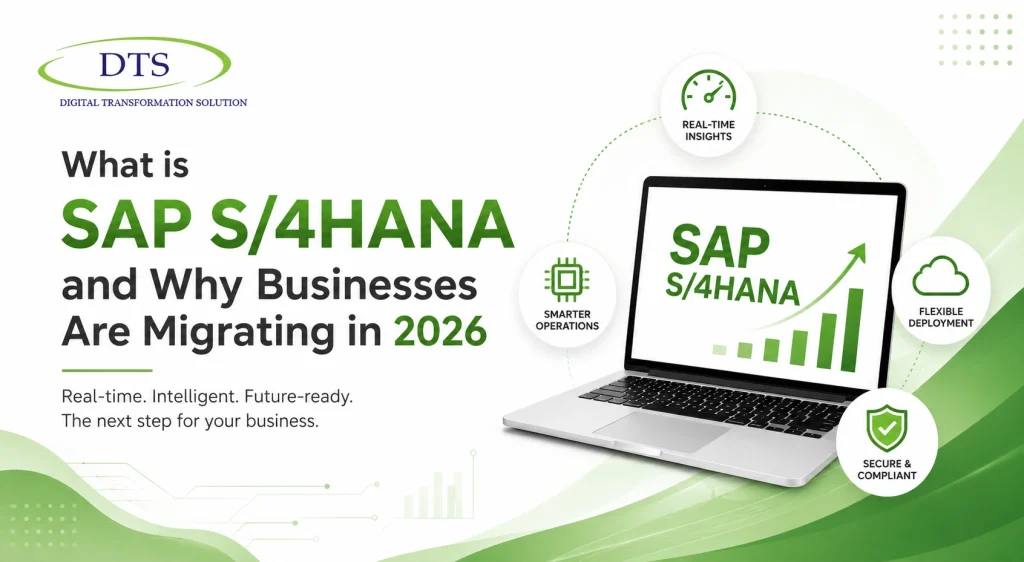
If you run a business that still depends on SAP ECC, you’ve probably heard the same warning from every SAP partner, consultant, and IT vendor lately: the clock is running out. SAP has confirmed that mainstream maintenance for ECC ends in 2027, and that single fact has turned “should we migrate to S/4HANA?” from a someday conversation into a this-year priority for thousands of companies.
But the deadline is only part of the story. S/4HANA isn’t just a newer version of the same software — it’s a fundamentally different way of running your business operations, built for real-time data, automation, and the AI-driven tools that are already reshaping how companies compete. In this guide, we’ll break down what SAP S/4HANA actually is, how it’s different from the ECC system you may already know, and why so many businesses are choosing to migrate now rather than later.
What is SAP S/4HANA?
SAP S/4HANA is SAP’s next-generation Enterprise Resource Planning (ERP) system. The name itself tells you a lot: “S/4” stands for the fourth generation of SAP Business Suite, and “HANA” refers to SAP’s in-memory database technology — High-performance ANalytic Appliance.
That in-memory database is the real breakthrough. Traditional ERP systems, including SAP ECC, store and process data on disk, which means reports and calculations often run in batches and take time to update. HANA stores data directly in memory (RAM), so information is processed almost instantly. In practical terms, that means your finance team isn’t waiting overnight for a report to refresh, and your supply chain team isn’t working off numbers that were accurate yesterday but not today.
S/4HANA also comes with a completely redesigned interface called SAP Fiori, which replaces the dense, transaction-heavy screens older SAP users are used to with a cleaner, role-based experience that works across desktop and mobile.
SAP S/4HANA vs SAP ECC: What’s Actually Different
It’s easy to assume S/4HANA is simply “ECC with a new coat of paint,” but the differences go much deeper than the interface.
| SAP ECC | SAP S/4HANA | |
| Database | Third-party (Oracle, SQL Server, etc.) | Native SAP HANA (in-memory) |
| Data processing | Batch-based, often delayed | Real-time |
| Data model | Complex, redundant tables | Simplified, fewer tables |
| Interface | Traditional SAP GUI | Modern SAP Fiori |
| Deployment | Primarily on-premise | On-premise, private, or public cloud |
| Future support | Mainstream maintenance ends 2027 | Actively developed, SAP’s current focus |
The simplified data model is worth pausing on. In ECC, the same piece of financial data might be stored and reconciled across several different tables. S/4HANA collapses much of that redundancy, which is a big part of why reporting and transaction processing are faster — there’s simply less for the system to sort through.
Why Are Businesses Migrating to SAP S/4HANA in 2026?
The SAP ECC deadline is closing in
This is the single biggest driver behind the current wave of migrations. Once mainstream maintenance ends, ECC systems stop receiving the security patches, legal updates, and technical support that keep a business-critical system safe and compliant. Staying on an unsupported system doesn’t just mean missing new features — it means operating with growing exposure to security vulnerabilities and compliance gaps that only get harder to justify over time. Many businesses that assumed they had years to plan are now finding the runway is shorter than expected.
Real-time data changes how decisions get made
When finance, sales, and operations are all working off numbers that update in real time, disagreements over “whose report is correct” tend to disappear. Businesses running S/4HANA report faster month-end closes, quicker demand forecasting, and the ability to spot problems — like a stock shortage or a cash flow gap — while there’s still time to act on them, instead of finding out weeks later in a report.
It’s the foundation for AI and automation
SAP has built its AI and machine learning capabilities to run natively on S/4HANA, not on ECC. Automated invoice matching, predictive inventory planning, and AI-assisted financial forecasting are all built with S/4HANA’s data architecture in mind. Businesses still on ECC aren’t just missing out on nice-to-have features — they’re building on a foundation that can’t support where enterprise software is heading next.
Competitors are already moving
Modern cloud ERP has become table stakes, not a differentiator. Competing platforms have spent the last several years pushing real-time, cloud-native ERP as the standard. Businesses that delay migration risk falling behind competitors who can already forecast faster, close their books quicker, and respond to market changes with far less lag.
Reporting and compliance expectations keep rising
Regulators and auditors increasingly expect faster, more detailed, and more traceable financial reporting. A real-time system with a cleaner data model makes that kind of reporting significantly easier to produce — and far less painful to prepare for an audit.
Benefits of SAP S/4HANA for Growing Businesses
- A single source of truth. Finance, sales, and supply chain teams work from the same live data, cutting down on reconciliation headaches and reporting delays.
- Built to scale. Whether you’re a mid-sized company or a large enterprise, S/4HANA’s architecture is designed to grow with transaction volume without the performance drop-off older systems experience.
- Flexible deployment. You’re not locked into one model — S/4HANA can run on-premise, in a private cloud, or on public cloud infrastructure, depending on what fits your business and budget.
- Better user adoption. The Fiori interface is significantly easier for new employees to learn, which cuts down training time and reduces resistance to change during rollout.
Cloud vs On-Premise S/4HANA: Which Should You Choose?
There’s no universal right answer here — it depends on your business’s size, IT resources, and risk appetite.
On-premise gives you full control over your infrastructure and customization, which suits businesses with complex, highly specific processes or strict data residency requirements. It also comes with higher upfront hardware and maintenance costs.
Cloud (public or private) shifts infrastructure management to SAP or a hosting partner, which usually means faster deployment, lower upfront cost, and automatic updates — a good fit for businesses that want to modernize without maintaining their own servers.
Many companies land on a hybrid approach, starting in the cloud for speed and flexibility, with the option to adjust as their needs evolve.
What Happens If You Don’t Migrate?
Staying on ECC past the support deadline doesn’t mean your system stops working overnight — but it does mean you’re running it without a safety net. No new security patches leaves you exposed to vulnerabilities that will go unpatched indefinitely. No legal updates makes it harder to stay compliant as regulations change. And the pool of consultants who specialize in older ECC systems is shrinking every year, since new SAP professionals are being trained on S/4HANA, not its predecessor. The longer a business waits, the more migration becomes a reactive, rushed project instead of a planned, strategic one.
How DTS Can Help You Migrate to SAP S/4HANA
Migrating your ERP system is not a decision to make lightly, and it’s not a project to run without the right expertise. Our SAP S/4HANA Implementation team works with businesses to plan and execute SAP S/4HANA migration projects that fit their actual operations — not a one-size-fits-all template. From evaluating whether a greenfield or brownfield approach makes sense for your business, to handling the technical migration, our SAP Support Center stays with you post-launch to make sure your move to S/4HANA strengthens your operations instead of disrupting them.
If your team needs to get hands-on with S/4HANA before or during the transition, our SAP S/4HANA training courses help staff build the practical skills to work confidently in the new system from day one.
If your business is still running on SAP ECC, now is the right time to start planning — not the year the deadline arrives.
FAQs
What does S/4HANA stand for?
S/4 refers to the fourth generation of SAP Business Suite, and HANA stands for High-performance ANalytic Appliance, SAP’s in-memory database technology.
Is SAP S/4HANA the same as SAP ECC?
No. While both are SAP ERP systems, S/4HANA runs on a different database architecture, uses a simplified data model, and offers real-time processing that ECC’s batch-based system doesn’t support.
Why are companies migrating to S/4HANA in 2026?
The main driver is SAP’s 2027 end of mainstream maintenance for ECC, combined with the demand for real-time data, AI readiness, and staying competitive with businesses that have already modernized their ERP.
What happens if I don’t migrate from SAP ECC?
Your system will stop receiving security patches and legal updates once mainstream maintenance ends, increasing your exposure to security and compliance risks over time.
How long does SAP S/4HANA implementation take?
Timelines vary based on company size and complexity, but most implementations take between six months and eighteen months from planning to go-live.
Is SAP S/4HANA cloud-based?
It can be. S/4HANA supports on-premise, private cloud, and public cloud deployment, so businesses can choose the model that fits their infrastructure and budget.
What is the difference between SAP S/4HANA and SAP Business One?
SAP S/4HANA is built for larger, more complex enterprises, while SAP Business One is designed specifically for small and mid-sized businesses that need core ERP functionality without the scale of a full S/4HANA deployment.